AMONG THE LIVING
AIDS took nearly
everyone Tez Anderson knew.
At 67, he is still walking
the circle of their names.
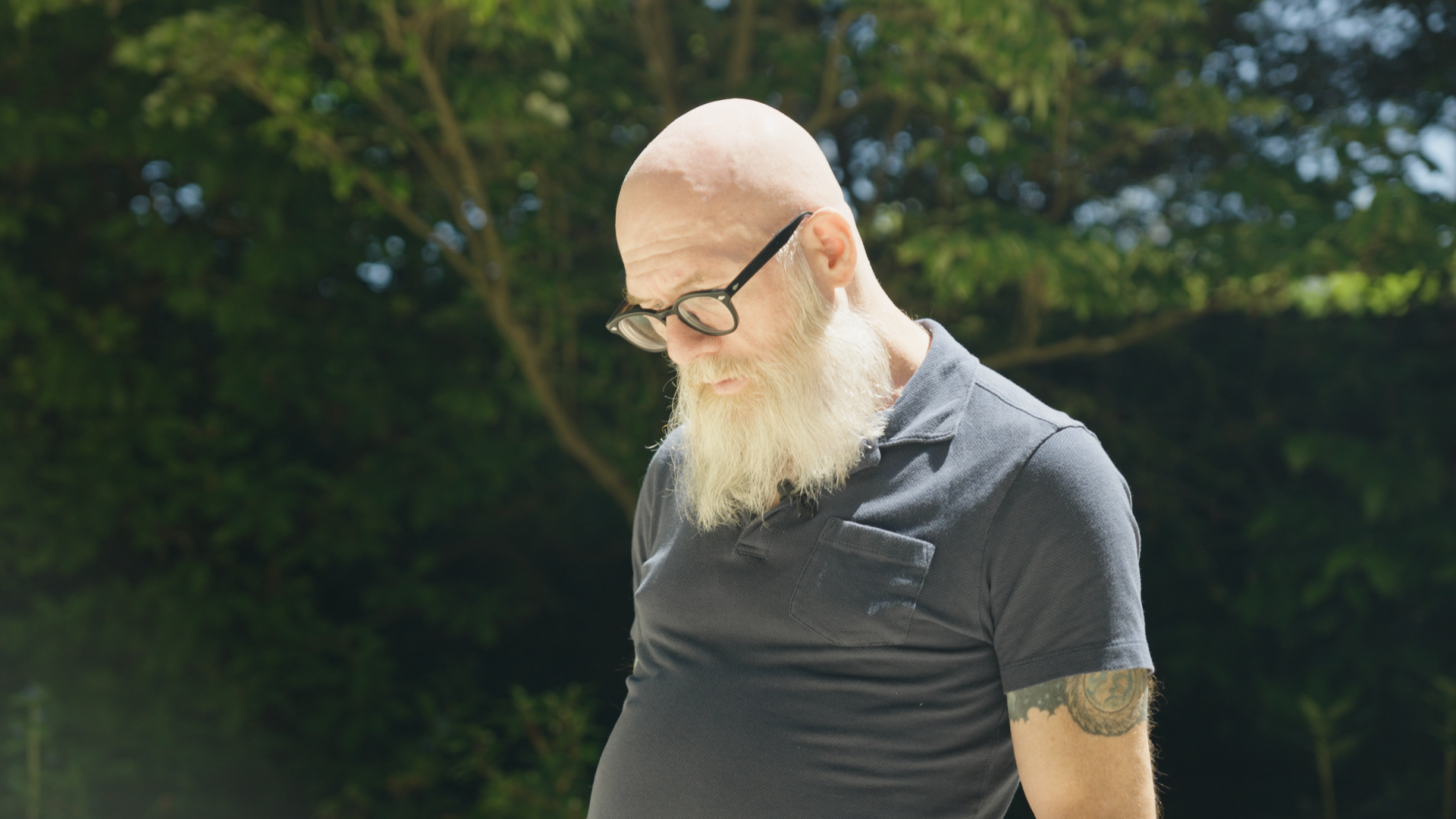
On a Tuesday morning in Golden Gate Park, Tez Anderson walks the Circle of Friends slowly. The Circle is the stone heart of the National AIDS Memorial Grove, a ring of names carved into the ground, thousands of them, each one a person the epidemic took. Anderson knows many of them. He stops when he finds one he recognizes.
"Every time I walk around," he says, "I see another name that I had forgotten that I knew."
His late husband's name is here. So are others — friends from the Castro, from the bars, from the years when the Bay Area Reporter ran page after page after page of obituaries. Anderson was 26 years old then, newly diagnosed, newly told he had 18 to 24 months to live. He had just moved to San Francisco. He had just started planning his death.
That was 1986. Anderson is 67 now.
Anderson has lived with HIV since 1983. He is what the medical community calls a long-term survivor, which is a designation for people diagnosed before 1996, the year highly active antiretroviral therapy arrived and changed the math of the disease. There are roughly 400,000 long-term survivors in the United States. Many of them are aging in isolation, navigating health systems that weren't built for them, carrying decades of grief that has no official name.
Anderson gave it one.
In 2013, he convened a town hall at a local LGBTQ+ center in San Francisco, expecting around 40 people to show up. More than 250 came. They wrote their experiences on giant sheets of paper pinned to the walls. They wrote about panic attacks, the nightmares, the inability to imagine a future, the guilt of having survived when so many others hadn't.
Anderson called what they were describing AIDS Survivor Syndrome, or ASS — a term he chose deliberately, with characteristic directness, and one he has spent the decade since working to legitimize. Working with Dr. Ron Stall, an HIV researcher at the University of Pittsburgh, Anderson helped identify its most common features: extreme emotional pain and depression, survivor's guilt, suicidal ideation, social isolation, fear of aging and difficulty envisioning a future. It shares features with PTSD and complex-PTSD but isn't fully captured by either. The DSM doesn't contain it. Most mental health professionals have never heard of it.
Anderson founded Let's Kick ASS — the nation's first and largest organization for HIV long-term survivors — out of that town hall. He founded HIV Long-Term Survivors Awareness Day, observed every June 5, the anniversary of the 1981 CDC report that first described the epidemic.
He built all of this in time he wasn't supposed to have.
The question of what to do with extra time is one Anderson has been working out for decades. When HAART arrived in 1996, when it became clear that he might actually live to be old, he found the prospect terrifying in ways he hadn't anticipated. He hadn't saved for retirement. He hadn't made plans. The panic attacks started. The nightmares. The sense that his brain, after so many years of proximity to death, had rewired itself for grief and was now being asked to do something else entirely.
What he settled on was empathy.
"I replaced my anger with genuine kindness and empathy," says Anderson, sitting on a bench near the Circle of Friends. "I think empathy could cure the world."
Anderson demonstrates this philosophy in small, specific ways. He stops at the Memorial Wall on 18th Street in the Castro to read a card someone has left for a neighbor who died. Pausing in the Grove when a stranger recognizes him as a fellow pioneer from the early years — a doctor named Stephen, it turns out, who now has a gay son, who has his own reasons to understand what was lost and what was built during the epidemic years. Two men who survived the same war, finding each other in a garden of names.
The war, in some ways, is not over. The Trump administration's FY2026 budget proposes eliminating all CDC HIV prevention programs — roughly $1.5 billion in cuts — and ending part of the Ryan White HIV/AIDS Program, which for more than three decades has been the primary federal support for Americans living with HIV who can't afford private care. A Johns Hopkins analysis projects that eliminating Ryan White would lead to a 49% increase in new HIV infections in the United States by 2030.
Anderson takes three pills a day and receives a shot every six months to keep his viral load undetectable. He has developed multi-drug resistance over the decades.
"I look in the mirror in the mornings," he says, "and I'm like, who's that old man looking back at me? I've earned these wrinkles. I've earned this gray. It wasn't easy getting it."
He has been asked what it feels like to still be here. His answer is not complicated.
"Survival is noble."